Why Writing Software Matters
Every piece of software is a set of decisions about how a business works. Here's why I think it matters who makes them, and how they're written down.
 Jason Shipps
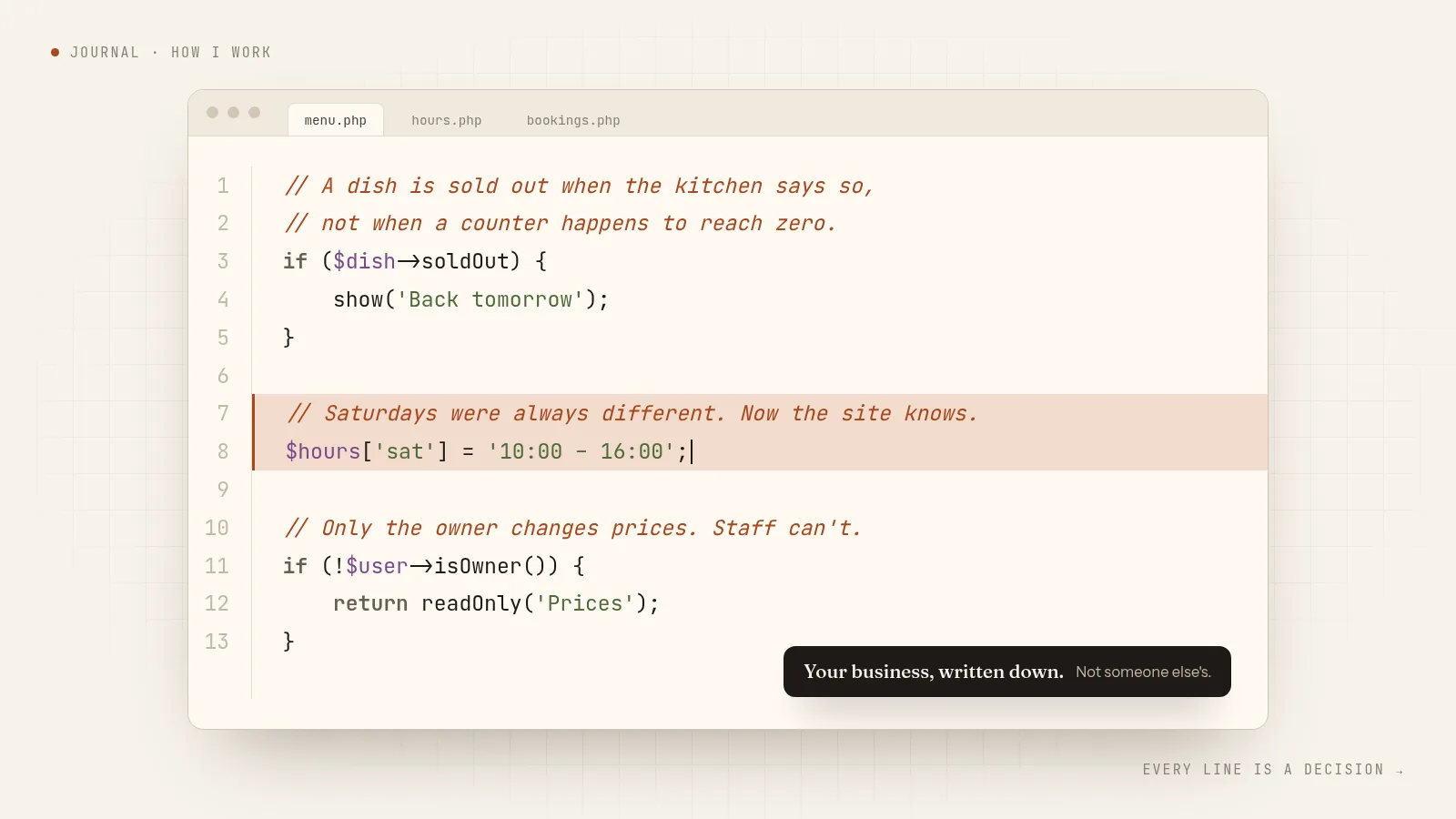
Every piece of software you use was written by someone. Someone decided what the buttons say, what happens when you press them, and what the screen shows when something goes wrong. Most of the time you don't notice those decisions. You only notice them when they don't fit, like a booking form that can't handle your Saturday hours or a shop that won't let you sell something in two sizes.
That's why I think writing software matters, and why I still write it myself.
Software is a set of decisions
People often picture code as something technical and neutral, like plumbing. It's closer to writing down how a business works.
When I build a site for a café, I'm deciding how a menu is organized, what counts as "sold out", and who can change the prices. When I build one for a repair shop, I'm deciding what a booking is, how long a job takes, and what the customer sees when the calendar is full.
Every one of those is a business decision before it's a technical one. If the person writing the software doesn't understand the business, the software makes those decisions for you, and usually makes them for an average business that isn't yours.
Off-the-shelf means someone else decided
Website builders and big plugins are written for millions of people at once. That's what makes them cheap to start with, and it's a fair trade for a lot of businesses.
The cost shows up later. You fit your business to the tool instead of the other way around:
- You work around it. A field you need doesn't exist, so the information goes in a note that nobody reads.
- You pay for what you don't use. Features built for other businesses still load, still need updates, and still break.
- You can't change the rules. When the platform changes its pricing or its editor, you change with it.
None of this is a disaster on day one. It adds up over years, which is how long a business website actually lives.
Good software is mostly about leaving things out
The hardest part of writing software isn't adding features. It's deciding what doesn't belong.
A small, well-written program is easier to understand, faster to load and harder to break. Every line I don't write is a line nobody has to maintain, update or debug at eleven at night. When I build an admin panel, the goal is that every field on the screen is one the owner actually uses.
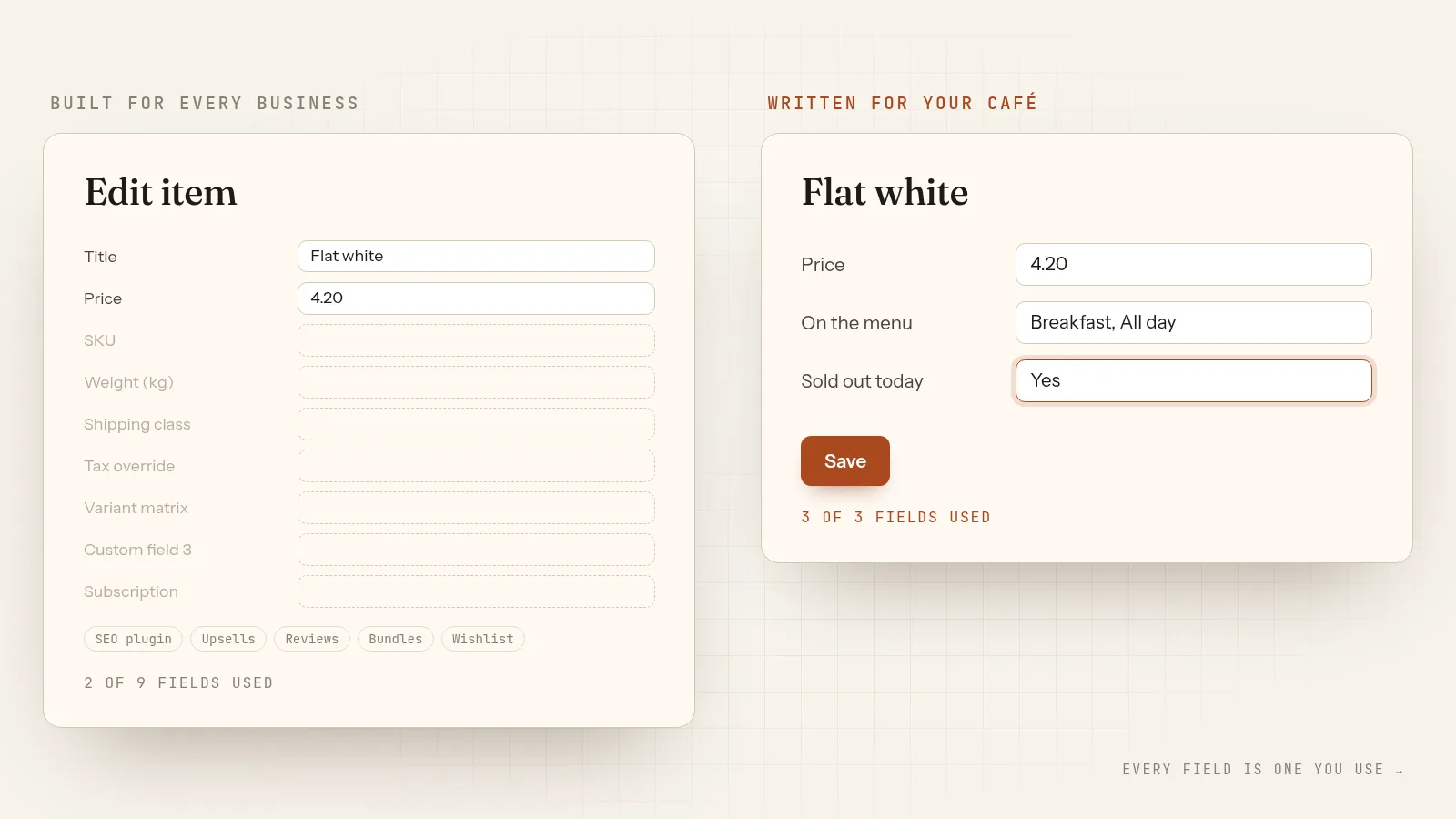
That takes more thought up front than installing a plugin. It also means the site still makes sense in five years, to you and to whoever works on it next.
Writing it well matters as much as writing it
Software that works today but that nobody can read is a liability. It ties you to the one person who understands it.
So I try to write code the way I'd want to inherit it:
- Plain and boring, without clever tricks that only make sense to me.
- Few dependencies, so it doesn't break when someone else's project is abandoned.
- Your data in one place, in a format that's easy to back up and move.
Any competent developer should be able to open the project and find their way around. If I've done my job, you're never stuck with me. You stay because it's working.
Why it matters to you
You don't need to care about code to care about this. You'll feel it in smaller ways:
- Updating your hours takes a minute instead of an email and a week.
- Your site loads quickly on a phone in a car park with one bar of signal.
- Nothing breaks after an update you didn't ask for.
- When something does go wrong, the person who wrote it can fix it, because they understand all of it.
Software runs a bigger share of every small business each year: how customers find you, book you, pay you and get in touch. It's worth having it written by someone who took the time to understand how you work.
If you'd like software built around your business rather than the other way around, tell me about it. I'll reply within one business day, with next steps or an honest no.